Projects
EXAGREE: Explanation Agreement in Explainable Machine Learning
This project studies how different stakeholders may prefer different explanations, even for the same predictive task. EXAGREE develops a framework for selecting stakeholder-aligned explanation models by balancing explanation faithfulness, usefulness, and agreement.
Keywords: explainable AI, explanation disagreement, stakeholder alignment, Rashomon sets.
Rashomon Sets and Explanation Uncertainty
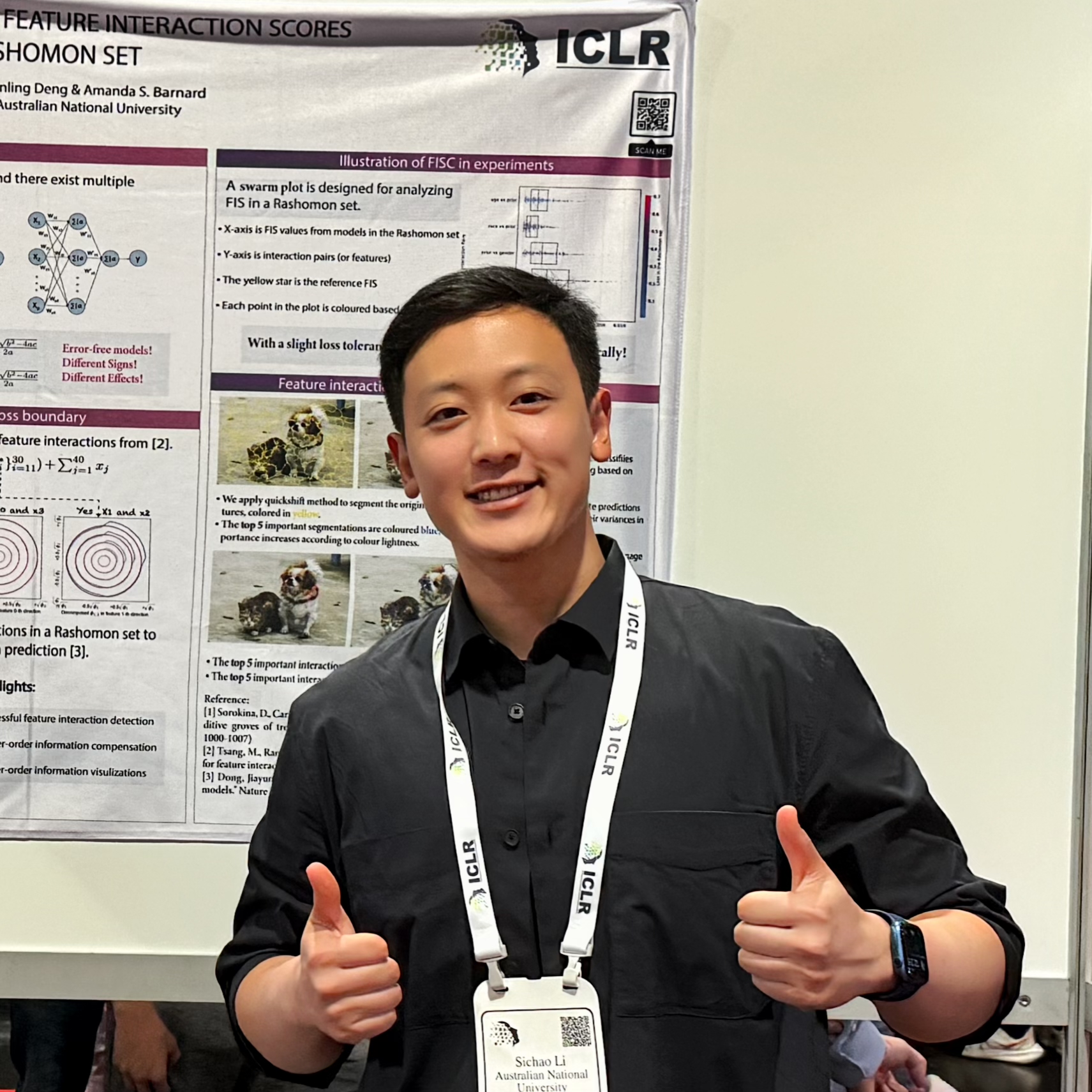
This project investigates the space of high-performing models that make similar predictions but produce different explanations. I develop methods for measuring attribution variance, feature interaction disagreement, and explanation instability across Rashomon sets.
Keywords: Rashomon effect, feature attribution, feature interaction, model uncertainty.
Concept-based Monitoring for LLMs
This project develops concept-level representations for monitoring LLM predictions and reasoning. The goal is to move from opaque token-level traces toward interpretable diagnostic concepts that can support model validation, governance, and failure analysis.
Keywords: LLMs, concept extraction, monitorability, reasoning faithfulness.
Trustworthy AI for Scientific Discovery
This project develops interpretable and robust machine learning methods for scientific domains, including materials science, chemistry, battery compounds, and neuroscience. The central goal is to make AI systems scientifically meaningful rather than only predictive.
Keywords: AI for science, materials informatics, molecular explanations, neuroscience.
Learning-preserving AI Tutors
This project studies how AI tutors can support student learning without replacing student effort. The aim is to design learner-state-aware tutoring systems that provide scaffolding, feedback, and misconception diagnosis while preserving student ownership of learning.
Keywords: AI in education, LLM tutors, student simulation, learning analytics.