Research
My research focuses on trustworthy and explainable artificial intelligence, with an emphasis on how AI systems can be understood, validated, monitored, and governed by human stakeholders.
Stakeholder-centred Explainable AI
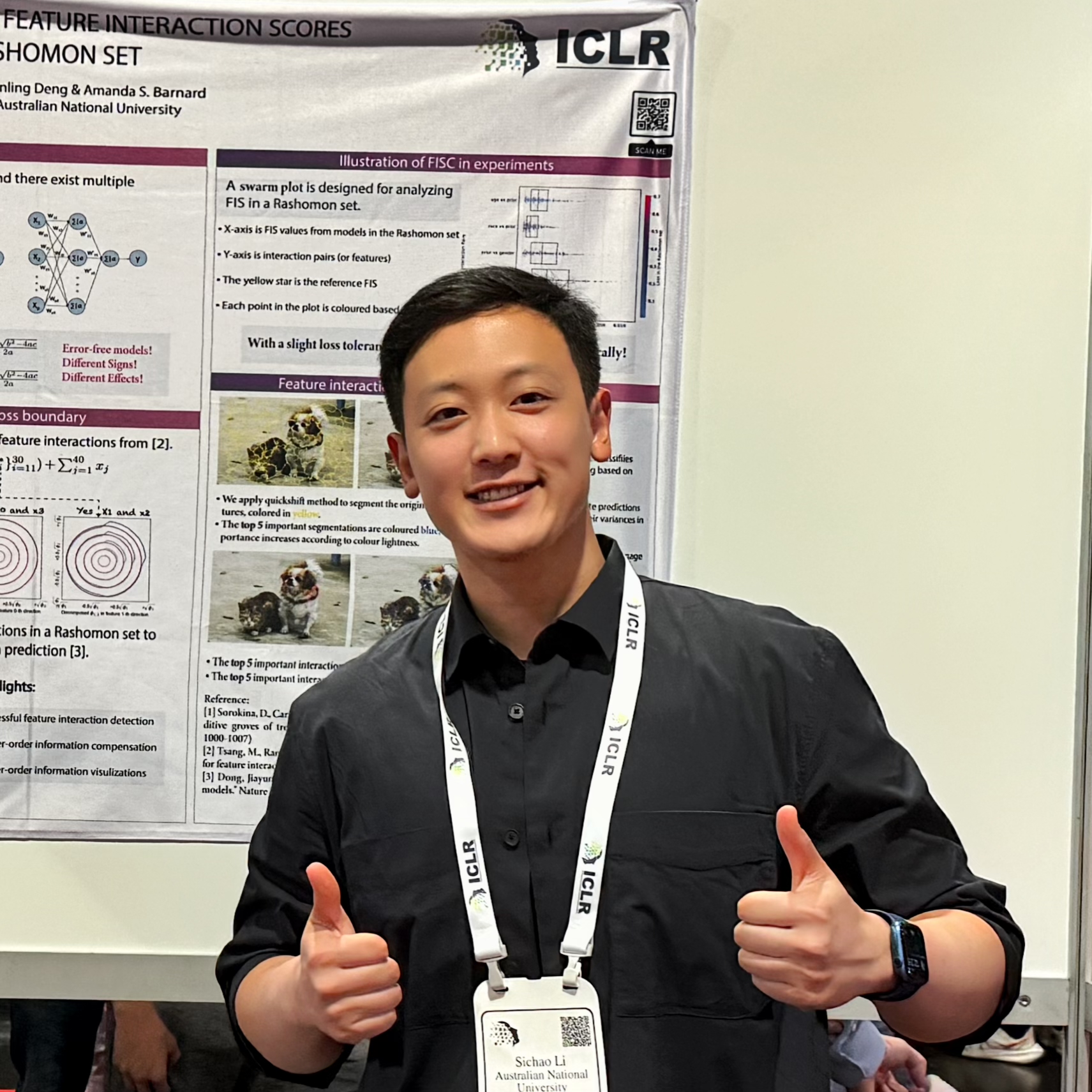
A core theme of my work is that high-performing models can disagree in their explanations. Instead of treating explanation disagreement as noise, I study it as an object of scientific and practical importance. My work on Rashomon sets, variance tolerance factors, feature interaction score clouds, and explanation agreement develops tools for understanding the space of plausible explanations produced by near-equally performing models.
Key topics:
- Rashomon sets and explanation uncertainty
- Feature attribution and feature interaction disagreement
- Stakeholder-aligned explanation model selection
- Faithfulness-usefulness trade-offs in explanation evaluation
Trustworthy and Explainable LLMs
I am extending my work on explanation disagreement and stakeholder-centred interpretability to large language models and multimodal models. I am particularly interested in how reasoning traces, concepts, and model behaviours can be monitored and validated in high-stakes settings.
Key topics:
- Concept-based LLM monitoring
- Reasoning faithfulness and monitorability
- LLM understanding benchmarks
- Agent safety and decision accountability
- Normative and scientific reasoning in LLMs
AI for Scientific Discovery
My doctoral and collaborative research applies interpretable machine learning to scientific discovery, especially in materials science, chemistry, and neuroscience. I develop methods that combine predictive performance with scientific relevance, domain constraints, and interpretable decision support.
Key topics:
- AI for materials discovery
- Battery materials and multimodal scientific learning
- Molecular representation and regional explanations
- Neuroscience and interpretable neural dynamics
- Human-centred AI interfaces for scientific reasoning
AI in Education
I also develop research on responsible LLM use in education. My current interest is in learning-preserving AI systems: tools that support student progress without replacing student reasoning, effort, or ownership.
Key topics:
- Learner-state-aware AI tutoring
- Student simulators and learning traces
- LLM-assisted project management and software education
- AI assessment design and governance
- Responsible AI use in higher education